
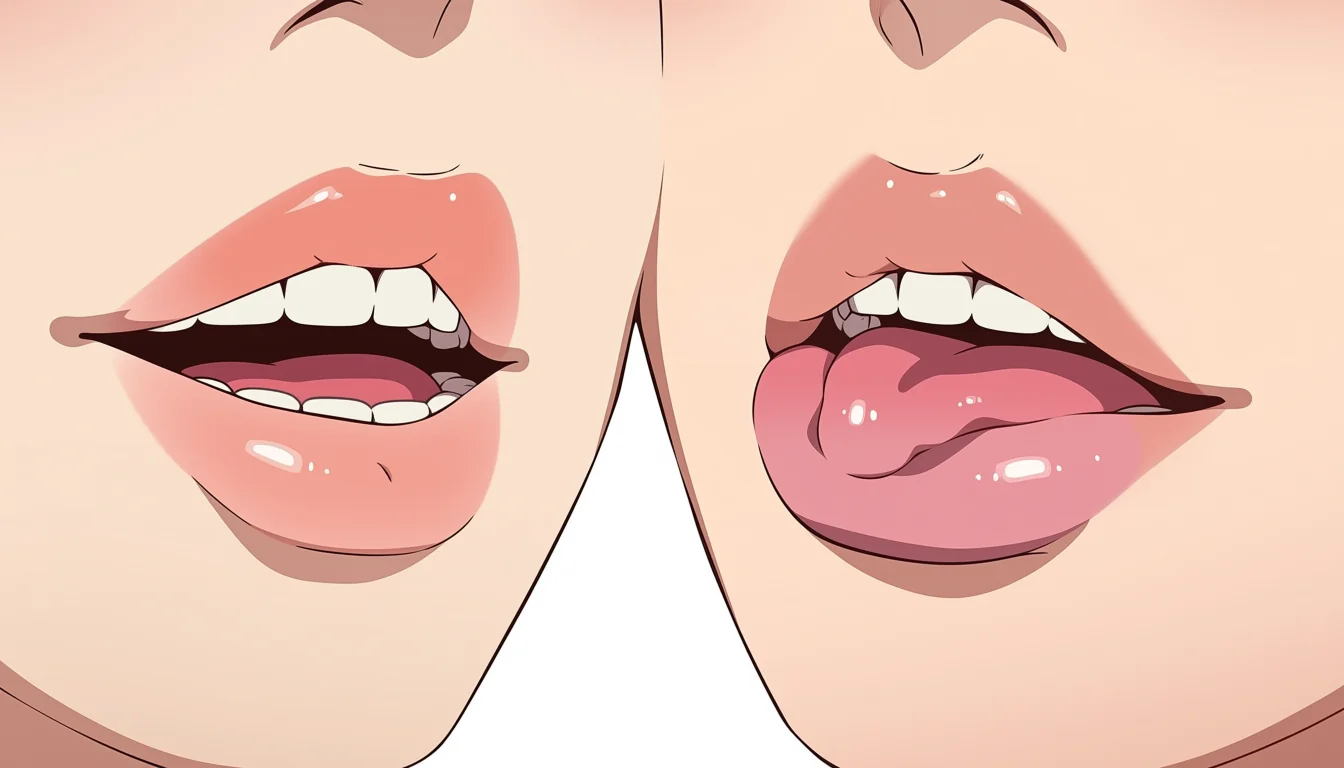
A very large proportion of drawn faces go wrong at the mouth, and almost always for the same reason: the mouth has been drawn as a flat symbol pasted onto the front of the face rather than as a form wrapping around the curved arch of teeth and jaw underneath. Once that curve is present, most other problems solve themselves.
This matters more in close work than in general figure drawing, since intimate framing puts mouths at large sizes where errors cannot hide. It is also one of the fastest improvements available, because the correction is structural and takes minutes to learn rather than months to practise.
The arch underneath
Teeth sit in a horseshoe, not a line. That horseshoe curves away from the viewer at the corners, which means the mouth is always wrapping around a cylinder, and its ends recede. A mouth drawn as a straight line or a flat oval sits on the surface of the face like a sticker, and no amount of shading will rescue it.
The practical fix is to draw a light curve for the arch before anything else, in whatever perspective the head is in, and place the mouth on it. In three-quarter views this immediately produces the correct asymmetry, with the near half larger and the far half foreshortened.
Lips have planes
The upper lip generally angles downward and away, catching less light. The lower lip angles upward and outward, catching more, with a soft shadow beneath it where it overhangs the chin. That difference is most of what makes lips read as three-dimensional, and reversing it is a common error that makes a face look subtly wrong.
There is also a defined edge where lip meets skin, sharper on the upper lip than the lower. In stylised work this can be reduced to a hint, but it should be the right hint. The general principle about shading by form rather than by outline is covered in the piece on drawing soft structure.
Expression starts at the corners
Most expression changes register at the corners of the mouth before they change the opening. A corner pulled back and slightly up reads differently from one pulled down, even when the gap between the lips is identical. Artists who animate or draw expression by changing the opening alone produce faces that seem to be miming rather than feeling.
The corners also connect to the rest of the face. A genuine expression involves the cheeks and the area around the eyes, and a mouth changed in isolation reads as false, which is occasionally the effect you want and usually is not.
Open mouths need interiors
An open mouth drawn as a dark shape reads as a hole. What makes it read as a mouth is minimal interior structure: the curve of the upper teeth, a suggestion of the tongue sitting behind and below, and a value that is dark but not black, because the interior is lit indirectly rather than not at all.
The tongue is a muscular mass with a rounded top surface, and it sits low in the mouth at rest. Drawn as a flat pink shape it looks pasted on; drawn with a top surface catching light and a shadowed underside, it reads as an object with volume, which is all that is required at most sizes.
Stylisation still needs the structure
Highly simplified styles reduce the mouth to a few marks, which is fine, but the marks have to be placed on the underlying curve. That is why a simple line in a good drawing reads as a mouth and the same line in a weaker one reads as a scratch. The simplification is a summary of structure, not a replacement for it.
This is the same relationship between structure and style described in the piece on stylised proportion, where drawn shorthand turns out to encode information that has to be there to be summarised.
Getting a mouth to sit on a face
Order of operations: draw the dental arch in perspective, place the mouth on it, establish the two lip planes, adjust the corners for expression, and add interior structure only if the mouth is open. Five steps, none of which involve rendering, and together they fix the majority of mouths that look wrong.
Characters here are fictional and unmistakably adult, and facial proportion is settled on the character sheet as described in the sheet piece.