
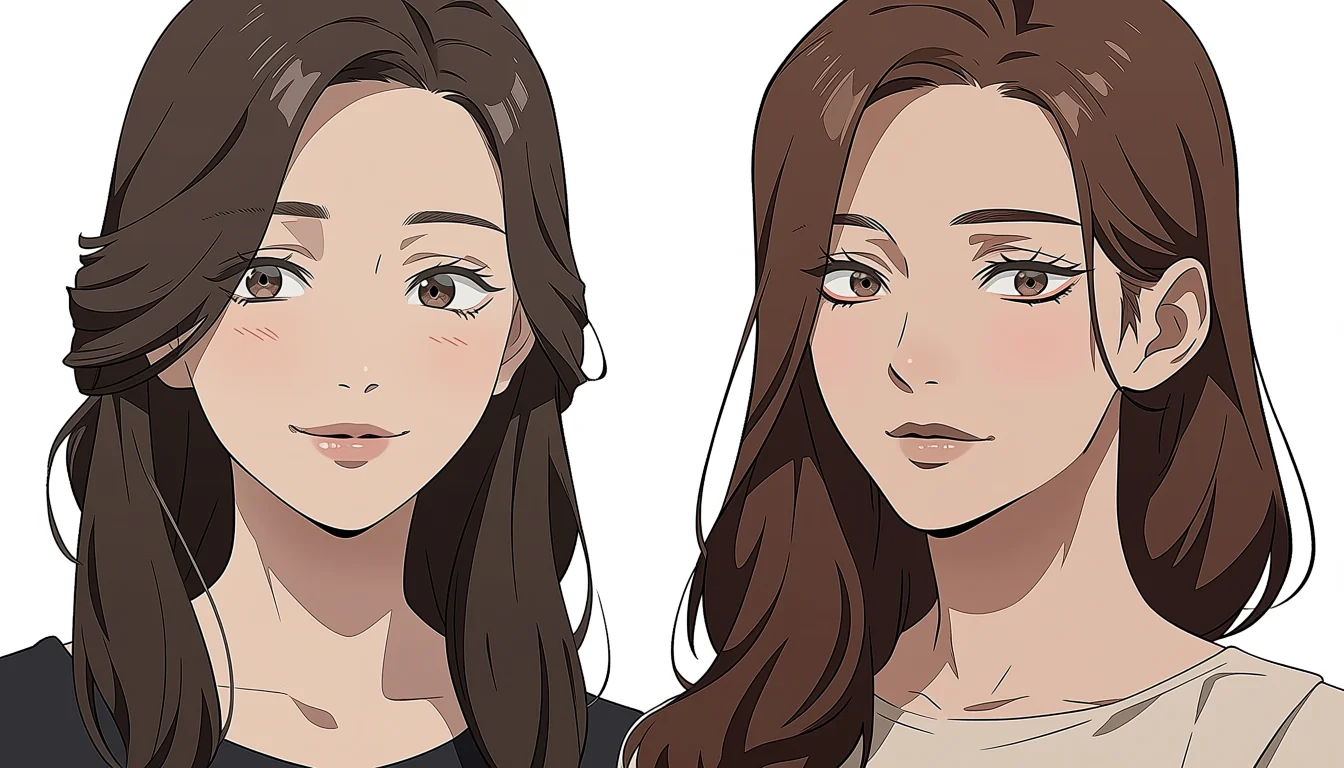
An overwhelming majority of drawn adult characters read as being in their early twenties, regardless of what the story says about them. This is partly stylistic convention and partly a skill gap, because drawing an older adult convincingly requires structural changes that most artists have never practised, and applying surface detail instead produces something that looks damaged rather than older.
Getting this right widens the range of stories available and improves cast legibility, since bodies that differ structurally are easy to tell apart. It also matters for a genre where nearly everybody looks the same age, which flattens both the drawing and the writing.
Structure changes first
Over decades the ribcage settles slightly, the spine's curves become more pronounced, the neck shortens visually as the shoulders round, and the distribution of soft tissue shifts downward. These are proportion changes, and proportion is what readers use to judge age at a glance, well before any detail is visible.
Because they are proportion changes, they survive stylisation. A heavily simplified drawing can still carry them, which is why a good caricaturist can convey age with five lines. Artists who try to convey it with rendering instead usually end up with a young face wearing texture.
Posture and how weight is carried
How somebody stands says more about their age than their skin does. Weight settled onto one hip, a slightly forward head position, arms held closer to the body, a shorter step. These are habits accumulated over years and they read instantly, because viewers have seen them their whole lives without ever having them pointed out.
Movement follows the same rule. Economy of motion increases with age: fewer unnecessary movements, more efficient paths, more use of available support. In animated work this is where age really lives, and it is closely related to the weight and settle questions in the piece on floaty motion.
Surface marks need a structure to sit on
Lines around the eyes and mouth are not applied decoration; they form where the face has folded repeatedly in the same places, following the muscles underneath. Drawn on a young structure they look like scratches. Drawn following the actual planes of expression they read as history, and they can be extremely subtle and still work.
The same is true of the body. Stretch marks, scars, sun damage and changes in skin quality all follow structure and history. A single well-placed mark that clearly belongs to a life is worth more than a general texture pass, and it also individualises the character, which is the particularity argument from the piece on the nude and the naked.
Clothing and setting carry a lot
Wardrobe communicates age very efficiently: what somebody has owned for a decade, what has been repaired, what was bought for a job. A room does the same, accumulating objects that only somebody who has lived a while would have. Both channels are free, in the sense that they cost no additional figure drawing.
The fabric behaviour that carries this is covered in the piece on how fabric describes a body. A garment that has taken the shape of its wearer over years looks different from a new one, and that difference alone can add a decade to a character.
Range across a cast
A cast where every adult reads the same age is a cast with one channel of information switched off. Varying it makes characters distinguishable, gives relationships different textures, and opens stories that a uniformly young cast cannot support. This is the same argument for structural variety made in the piece on the default body.
The fixed requirement remains unchanged in both directions: every character is fictional and unmistakably adult. Range means variety among adults, never ambiguity about whether somebody is one.
Drawing an adult who has a past
The working order is structure, posture, movement, then a small number of surface marks that follow the structure, then wardrobe and setting. Doing it in that order means age is built in rather than applied, and built-in age survives stylisation, small reproduction sizes and every subsequent revision.
The character-level version of this belongs on the sheet, as described in the sheet piece.