
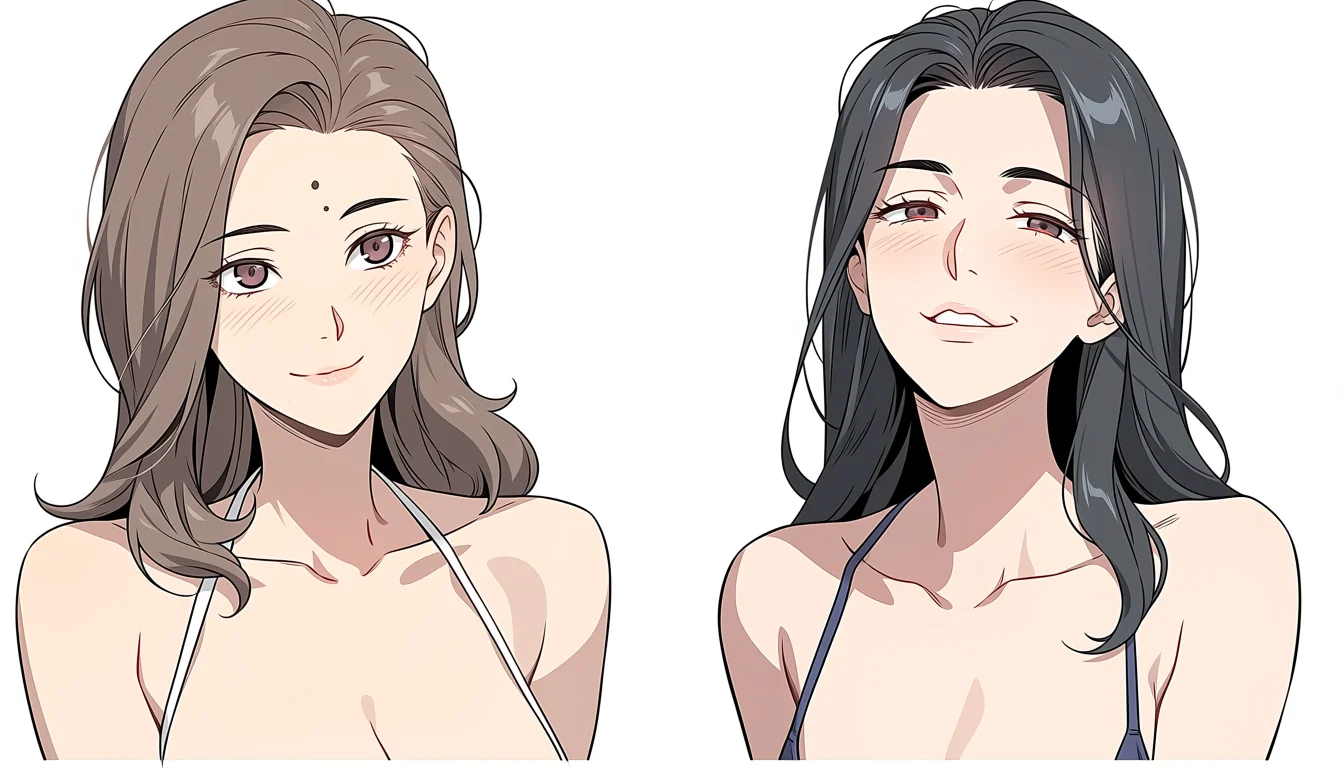
Look at enough drawn adult work from any single tradition and a default body emerges: a narrow band of height, proportion and shape that most characters sit inside. Nobody wrote it down. It formed by copying, because artists learn from what they read, and what they read was drawn by artists who learned the same way. Defaults are self-reinforcing and largely invisible from inside.
Naming it is useful for two reasons. It explains a real limitation on what stories the genre can tell, and it is a practical opportunity, since work that steps outside the default is noticed immediately in a field where most work looks similar to most other work.
How a default forms
Nobody decides. An influential work establishes a look, imitators copy it, a second generation copies the imitators, and within a decade the shape has been abstracted into a set of construction rules taught in tutorials as though they were anatomy. At that point departing from it feels like an error rather than a choice, which is how conventions defend themselves.
Commercial pressure accelerates it. Editors and clients ask for what has sold, artists supply it, and the range narrows further with each cycle. Nothing in this process involves anyone believing the default is the only acceptable body; it just requires everybody to be slightly risk-averse at the same time.
What a narrow default costs
The obvious cost is that readers whose bodies fall outside it rarely see anything resembling themselves, which matters more in intimate material than in most genres. The less obvious cost is narrative. Bodies carry information about a character's history, work, age and habits, and a cast that all shares one build has thrown that channel away entirely.
It also flattens casts visually. Two characters who differ only in hair colour are hard to tell apart at reading distance, which is the silhouette problem set out in the character sheet piece. Variety is not only a representational question; it is basic legibility.
Variation has to be structural
Widening the range is not achieved by scaling one design. Different bodies have different proportions between torso and limb, different shoulder-to-hip relationships, different ways of carrying weight and different postures that follow from all of it. A design that has simply been made larger or smaller reads as the same character resized, and readers see through it immediately.
The 3D version of exactly this problem is described in the piece on morph targets, where one base mesh produces a cast that all looks related. The drawing equivalent is one construction method producing a cast that all shares a skeleton. Both need genuinely separate starting points rather than adjustments.
Range is noticed quickly
In practice, artists who draw a genuine range of bodies get noticed for it, and the reason is simple: it is rare, and rarity is visible. Readers describe such work as feeling real or as having actual people in it, which is a comment about variety rather than about rendering, though it usually gets attributed to skill.
It is also a durable advantage rather than a trend, because it comes from observation rather than from a style. Artists who draw from life regularly accumulate this almost automatically, which is the least glamorous and most reliable piece of advice available in this area.
Reference is the practical lever. Artists who work only from other drawings inherit whatever those drawings assumed, while artists who work from photographs, life drawing sessions and observation accumulate range without having to think about it. The narrowness is not usually a belief anybody holds; it is simply the range of inputs a person happened to have, and inputs are something you can change deliberately in an afternoon.
Widening the default in your own work
Start with the cast list rather than the drawings. Decide the range before designing anyone, so variety is a requirement rather than an afterthought. Then build each design from its own structure, and check the whole cast as silhouettes together to confirm they read apart at small size.
Every character stays fictional and unmistakably adult regardless of build, which is a fixed requirement described in the reader agreement and in the piece on legible adult age.