
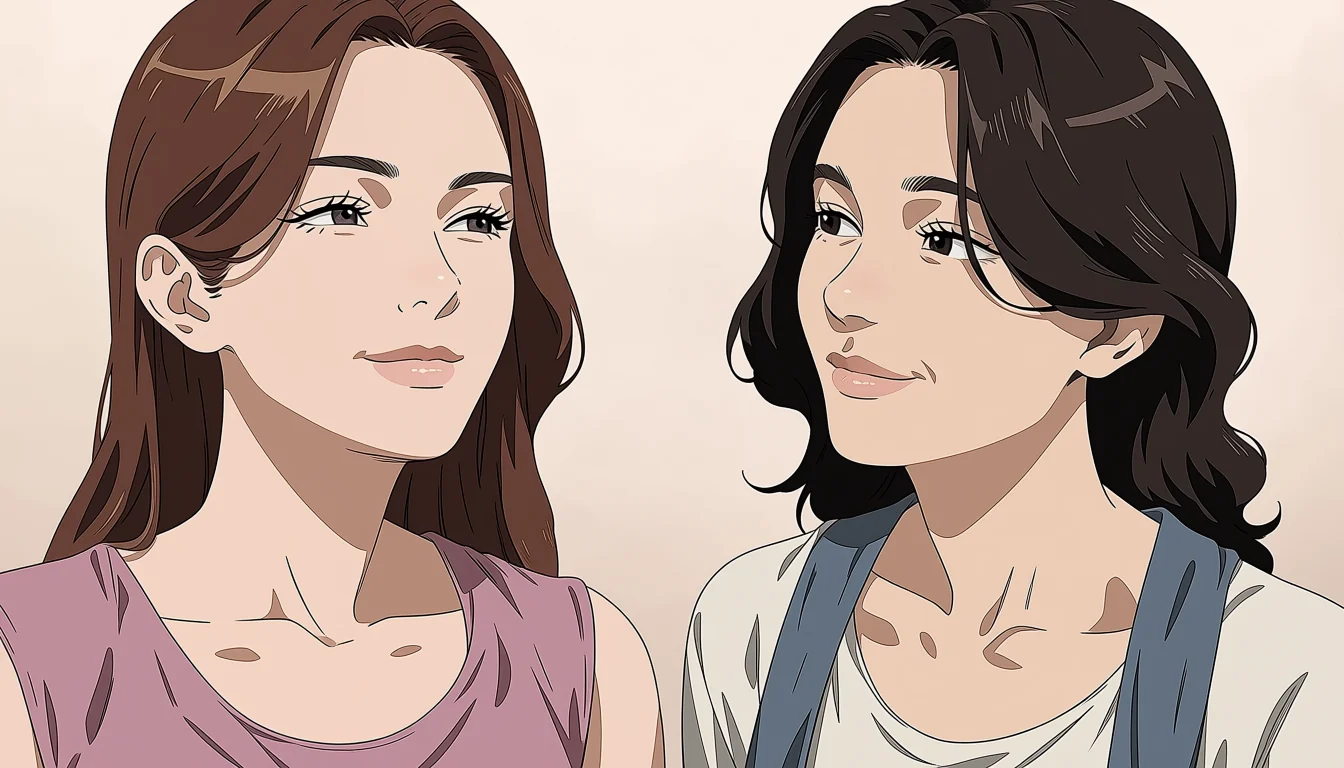
Two figures in close motion is where a lot of otherwise competent drawing falls apart, and the failure has a recognisable shape: limbs appear that cannot be traced to anybody, the depth order becomes ambiguous, and the reader spends a moment doing anatomy puzzles instead of following a scene. The causes are structural rather than a matter of drawing skill.
The good news is that the fixes are quick and they are the same fixes that improve any crowded composition. Nothing here requires drawing better, only arranging more deliberately before drawing at all.
Every limb must belong to someone
The single test is whether a reader can trace each visible limb back to a body without effort. If a hand appears near an edge with no visible connection, it reads as an error even when the anatomy behind it is correct. Ambiguity of ownership is the specific thing that produces the knot effect.
The fix is usually to show more of the connecting limb, or to move it so its path is visible. Occasionally it is to remove it from the frame entirely, which is often better than a partially visible arm whose owner is unclear.
Establish a depth order
One figure should be clearly in front. Ambiguous depth is what makes two bodies read as one confused mass, and it is solved by decisive overlap, as described in the piece on composing groups. Overlap a lot or not at all; small overlaps produce tangents that read as mistakes.
Value supports the same job. The nearer figure can be lighter or darker than the further one, and even a small separation in tone makes the depth order immediate. Doing this before rendering means the rendering has something to reinforce rather than something to rescue.
Silhouette difference does the work
Two figures with similar outlines merge. Give them different postures, different hair masses, different amounts of covering, and the reader separates them instantly. This is the cast-level argument from the piece on the default body, applied within a single image.
It also solves the problem at small sizes, where most readers meet the work first. Squint at the image and count the figures. If the answer is unclear, the arrangement needs changing before any more time is spent on it.
Continuity across panels or frames
In sequential and animated work, who is on which side must stay stable unless a deliberate move changes it. Readers build a spatial model quickly and are disproportionately annoyed when it breaks, which is the screen-direction discipline described in the blocking piece.
Small continuity anchors help: a piece of clothing, a distinctive hair length, a piece of furniture in shot. These let a reader reorient after a close panel without any explicit re-establishing shot, which saves space in a tight sequence.
Pose both figures together
Figures posed separately and then arranged together do not fit. Each one must be slightly compromised by the other, which is the mutual adjustment described in the piece on drawing two bodies in contact, and it can only be achieved by roughing both at once from the start.
Working from a rough that contains both, however scruffy, catches intersections, impossible angles and weight problems while they cost nothing. Fixing them at the finished stage usually means redrawing one figure entirely.
Negative space tells you when it is wrong
The shapes between and around two figures are a fast diagnostic. When an arrangement is working, those gaps are varied and irregular; when it is not, they tend to become either uniform slivers or one large amorphous hole, and both are visible at a glance long before the anatomy is finished.
Checking the negative space as an abstract pattern, ignoring what the shapes represent, catches problems that direct inspection misses because the eye keeps filling in what it expects. Flipping the image horizontally makes this easier still, since a mirrored view suspends recognition for a moment and shows the arrangement as design.
Keeping two moving figures readable
Trace every limb to an owner, commit to a depth order, differentiate silhouettes, keep continuity anchors, and rough both figures together. Five checks, all before rendering, and they prevent almost every version of the knot problem.
Characters here are fictional and unmistakably adult, and both participants must remain individually legible, as set out in the reader agreement.