
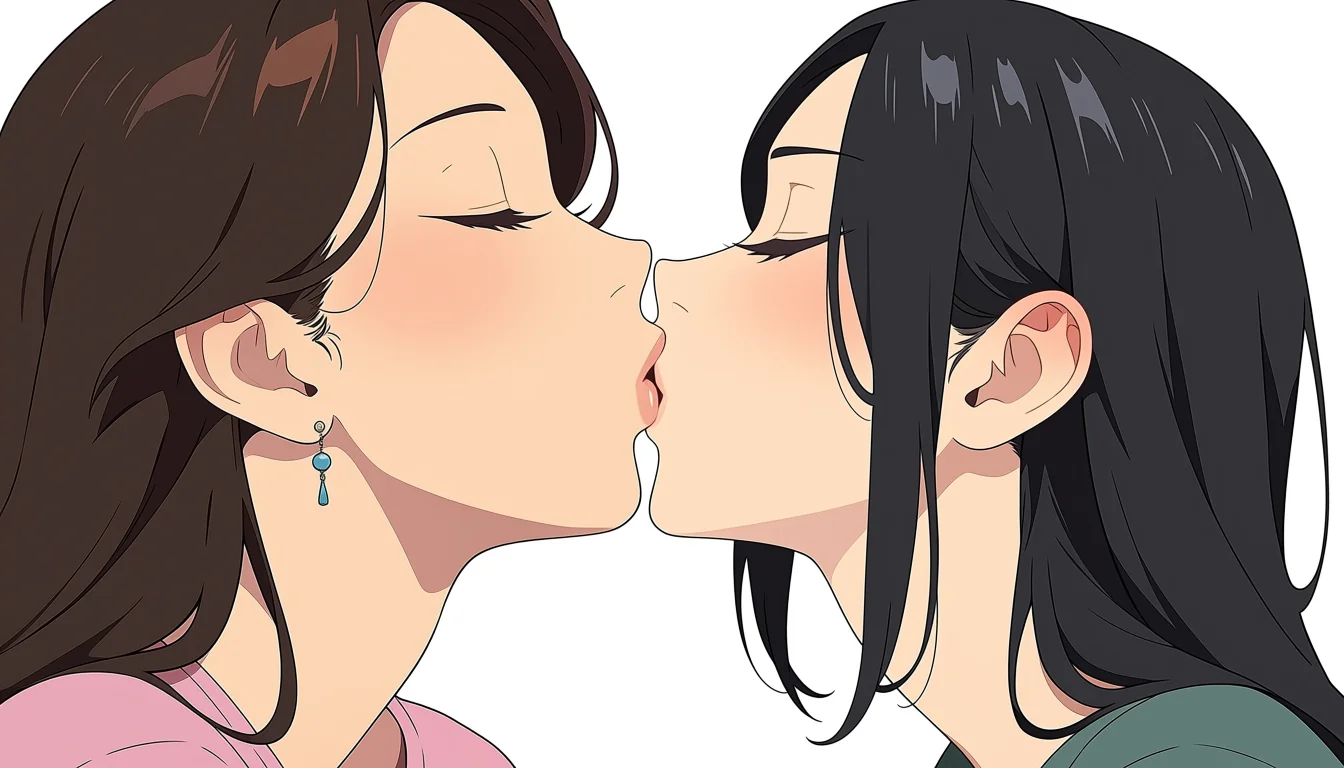
Ask a new animator to animate a kiss and you usually get two heads moving toward each other at constant speed until they touch. Everything technically happened. Nothing happened dramatically. The reason is that the meaningful part of a kiss is almost entirely before contact, and it is made of decisions, hesitations and permissions that the moving-heads version skips completely.
This is a general truth about intimate animation but it is easiest to see here, because a kiss is short, familiar, and something every viewer has strong intuitions about. Get the shape right on a kiss and the same structure transfers to almost any moment of physical closeness between two fictional adult characters.
Anticipation is the scene
Anticipation in animation normally means a small move opposite to the main one. Here it means something broader: the visible run-up during which both people decide. That includes a pause, a look, a breath, a slight lean that stops, and a second lean that continues. Each of those is a beat, and beats are what let a viewer follow a decision being made.
The proportions are surprising when you time them. In work that reads well, the run-up commonly occupies two or three times as long as the contact. Cut the run-up and the contact reads as arbitrary; extend it too far and it reads as indecision. Somewhere between one and three seconds covers most cases at ordinary playback speed.
Eye lines move first
Before anything physical, attention shifts. A look down to the mouth and back up is the single most legible signal available, and it costs a handful of frames. A blink held slightly long reads as consent. A gaze that stays fixed reads as challenge. None of this needs the body to move at all, which makes it very cheap for the amount it communicates.
The order matters. Eyes, then head, then body, then hands. Reversing that order produces the strange effect of a body arriving before its owner has decided anything, which is one reason clumsy intimate animation feels unpleasant rather than merely unconvincing. The piece on holds covers the timing side of the same principle.
Contact needs deformation
Two faces touching without any change of shape reads as two solid objects meeting. Real contact deforms: lips compress, a cheek gives slightly, a hand on a jaw presses in. In 3D this usually means corrective shapes fired by proximity; in 2D it means drawing the squash rather than assuming it. Either way it has to be authored, because nothing produces it automatically.
Pressure also implies a direction. Somebody is pressing and somebody is receiving, often swapping across the beat. Choosing that explicitly gives the moment a shape, and it prevents the mutual-mannequin look where both characters lean equal amounts at equal speed as though following the same instruction.
The moment after
Endings are where most attempts fall apart, because the animator has finished the interesting bit and cuts. What a viewer needs is a resolution: a small separation, eyes opening, a change of expression that tells you how it landed. That beat carries the emotional result, and without it the scene has an action but no consequence.
It is also the cheapest part of the shot to do well. A few frames of separation, a settle, and one clear expression change will finish a sequence that would otherwise feel unresolved. Do not spend the whole budget on the approach and leave nothing for the landing.
Sound, where you have it, does a large share of this work for free. A breath caught and released will carry a beat that would otherwise need twenty frames of animation, and a room tone that drops away at the moment of contact focuses attention better than any camera move. Animators without a sound budget should still cut the sequence as though one existed, because the rhythm it implies is the rhythm the images need anyway.
What makes an animated kiss read
In order: attention shifts, hesitation, decision, contact with deformation, and a resolution. Five beats, most of them short. The contact is the shortest and the least interesting of them, which is exactly the opposite of how most people allocate their time when they first attempt the shot.
Keep both characters fictional and unmistakably adult, and keep the decision-making visible, because visible decisions are what make closeness read as shared rather than done to someone. The staging side is in the blocking notes, and the wider standards are described in our editorial principles.