
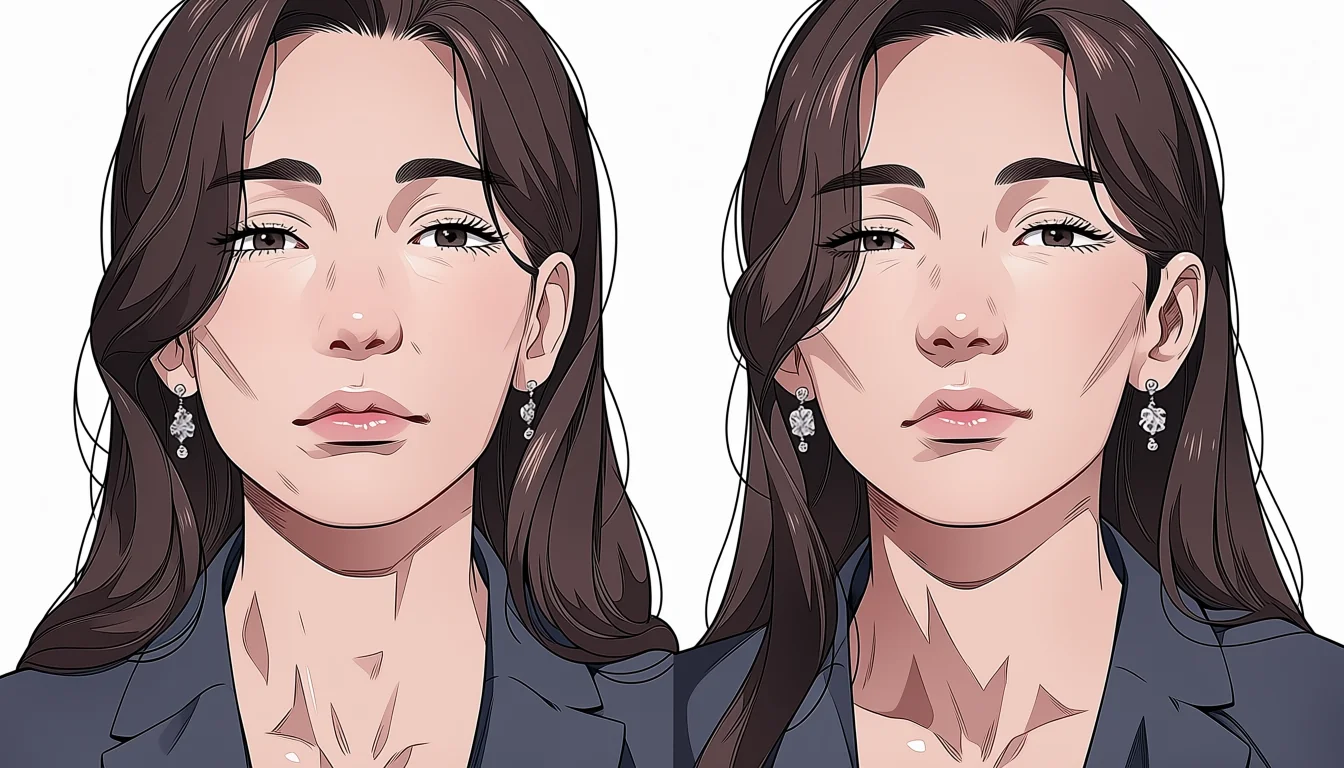
Beginner animation almost always has too much movement in it. Everything is going somewhere all the time, and the result is that nothing registers. Experienced work is mostly stillness with a few clear moves inside it. The stillness is not laziness; it is the mechanism by which a viewer gets a chance to notice the thing you spent a week on.
What a hold is for
A hold is a stretch of frames where a character stays essentially in one pose. During a hold, the audience catches up. They read the pose, register the expression, and take in the composition. Without holds there is no reading time, and complicated animation becomes visually equivalent to static noise: busy, unmemorable, and tiring after ninety seconds.
Holds also create rhythm. Move, hold, move, hold gives a scene a pulse, and pulse is what makes a sequence feel authored rather than generated. A conversation between two fictional adult women works the same way: the pauses carry the meaning, and the gestures punctuate them.
Moving holds, not frozen ones
In drawn animation you can hold a single drawing and it reads as a deliberate stylistic beat. In 3D the same thing reads as the render having crashed, because the image is too smooth and too consistent for a viewer to accept perfect stillness. So 3D uses moving holds: the pose stays, but something drifts slowly through it.
Usually the drift is a slow weight shift in the hips, a breath in the chest, and a small head settle, all at very low amplitude over twenty or thirty frames. Add a blink somewhere. That is enough. The audience will read the character as alive and will still take the pose as a hold rather than as an action.
In-between spacing is effort
Between two poses, the distribution of frames tells the viewer how hard the move was. Frames bunched at the start and spread through the middle read as a push that runs out of energy. Frames spread at the start and bunched at the end read as something falling or being pulled. Even spacing reads as machinery.
This is why the graph editor matters more than the pose library. You can have two excellent poses and a completely unconvincing move between them, and no amount of extra keys will repair spacing that was never shaped. Fix the curve, then judge the result, and only then consider adding detail on top.
Cutting before adding
When a shot feels wrong, the reflex is to add: more overlap, more secondary motion, more life. Try subtraction first. Delete every key that is not an extreme, watch it again, and see what the shot is actually about. Very often the problem was that three competing movements were fighting for attention and none of them won.
Then rebuild in order of importance: the main action, then the thing that follows it, then the small stuff. If you run out of time you will have run out having finished the parts that matter, which is not true of the other order.
Keep a note of what you cut and why. Half of it will turn out to be worth restoring in a later pass, and the other half will teach you which of your instincts is reliably wrong. Animators who improve fastest are usually the ones who can name the mistake they keep making, rather than the ones who simply make fewer mistakes by accident.
Why holds decide what a scene says
Two animators can key the same poses and produce different scenes entirely, because they chose different moments to stop. The hold is an editorial act. It says look here, now, at this. In intimate work it is also where consent and attention become visible, since a held look before a touch is what makes the touch legible as something chosen rather than something done.
Weight problems that survive good holds usually come from timing rather than pose, and that is covered in the notes on floaty motion. For the shot-level version of the same discipline, see the blocking piece, and the site's working standards are set out in our editorial principles.