
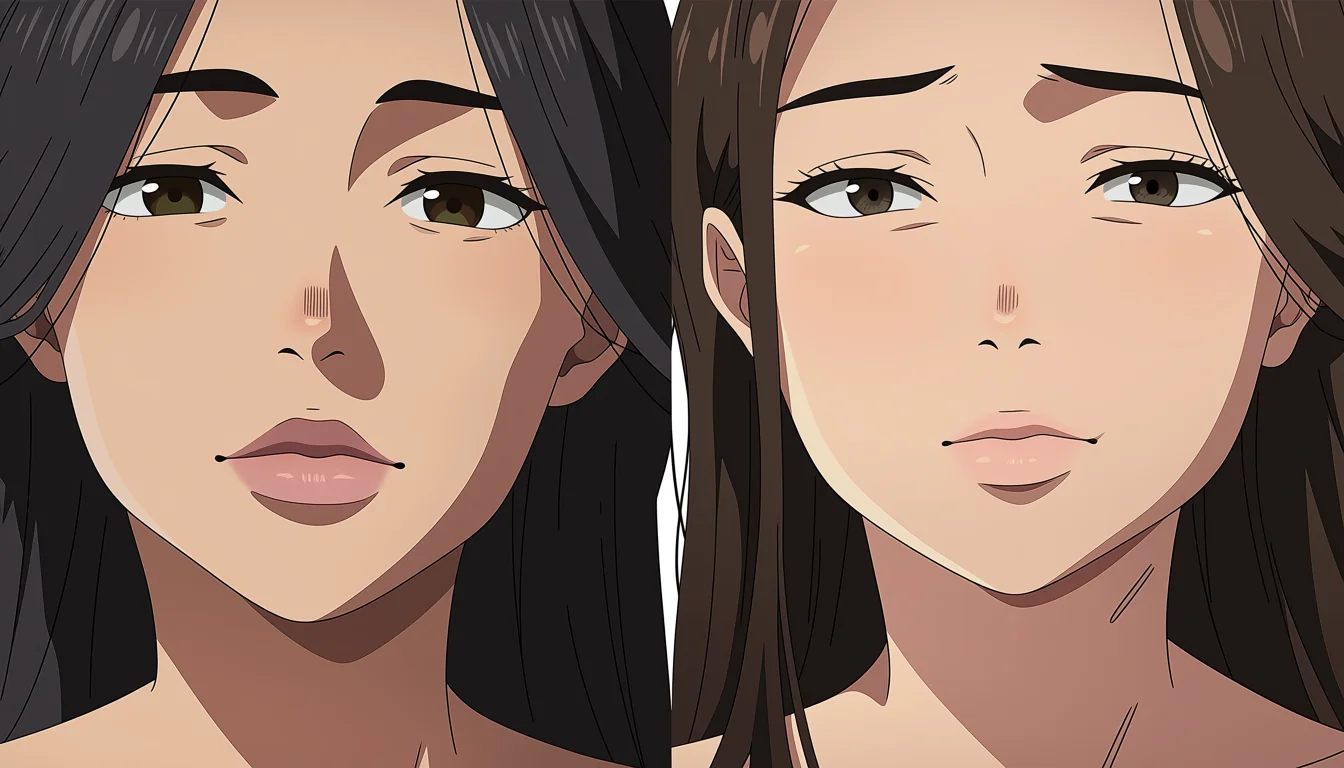
A beginner in a 3D scene treats the lens as a zoom: too much in frame, make it longer; not enough, make it wider. That works and it throws away the most useful control in the shot. Focal length changes the relationship between near things and far things, and those relationships are what tell a viewer how a space feels and how close they are standing.
What a lens actually changes
Move the camera back and put on a longer lens to keep the same framing, and the image changes anyway. The background gets bigger relative to the subject, the depth between foreground and background compresses, and a face loses the forward push of its nose and brow. Same framing, different world. That difference is the tool.
The underlying reason is simple: a wide lens close up means the near part of a subject is proportionally much closer to the camera than the far part, so it renders much larger. A long lens far away means near and far parts are almost the same distance, so they render at almost the same size. Everything else follows from that.
Wide lenses and what they say
A wide lens close to a character reads as intrusive, energetic, or intimate depending on context. It makes rooms feel larger and distances between people feel greater than they are. Two figures a metre apart on a wide lens look separated; the same two on a long lens look almost touching. That alone can carry a change in a relationship across a sequence.
The risk is distortion. Faces near the frame edge stretch, features closest to the camera balloon, and stylised designs with already-large features suffer fastest, as covered in the notes on stylised proportion. Below roughly 24mm equivalent, most character work starts to look like a joke unless the joke is intended.
Long lenses and what they say
A long lens flattens. Backgrounds come forward and turn into fields of colour, subjects separate from them cleanly, and the whole image acquires a slightly detached quality. It is the lens of watching rather than being present, which is why surveillance shots and quiet observational scenes tend toward it.
It also compresses the space between two people, which can read as closeness or as crowding. For a scene about two fictional adult women becoming aware of each other, a slow move from a wider lens to a longer one across the sequence does a lot of work that dialogue would otherwise have to do.
Choosing a lens set for a project
Real productions do not have infinite lenses; they have four or five, and that constraint improves the work. Pick a small set, for example 28, 40, 58 and 85, and shoot everything on those. The look becomes coherent, the camera department stops fiddling, and each choice starts to mean something because it contrasts with the others.
| Lens | Space feels | Faces | Common use |
|---|---|---|---|
| 24mm | Large, exaggerated | Distorted | Rooms, energy |
| 35mm | Roomy, natural | Slightly pushed | General coverage |
| 50mm | Neutral | Honest | Two-shots |
| 85mm | Compressed | Flattering, flat | Close reactions |
Beware of the default. Most 3D packages open with a camera somewhere around 35 or 50mm equivalent, and a great deal of amateur work is shot entirely at whatever that default happens to be. It is not a bad number, but a whole film made on one accidental lens has a monotony to it that nobody planned and nobody can quite diagnose later.
Using focal length as a decision
The habit worth building is to choose the lens before choosing the camera position, then move the camera until the framing is right. Doing it the other way round means the lens is whatever was left over, and the shot inherits a feeling nobody chose. This is the same argument as the one for locking geography in the blocking piece.
Try it as an exercise: shoot one moment four times on four lenses, matching framing each time, and put the results side by side. The differences are larger than most people expect, and once seen they are difficult to unsee. Our wider working standards are set out in the editorial principles.