
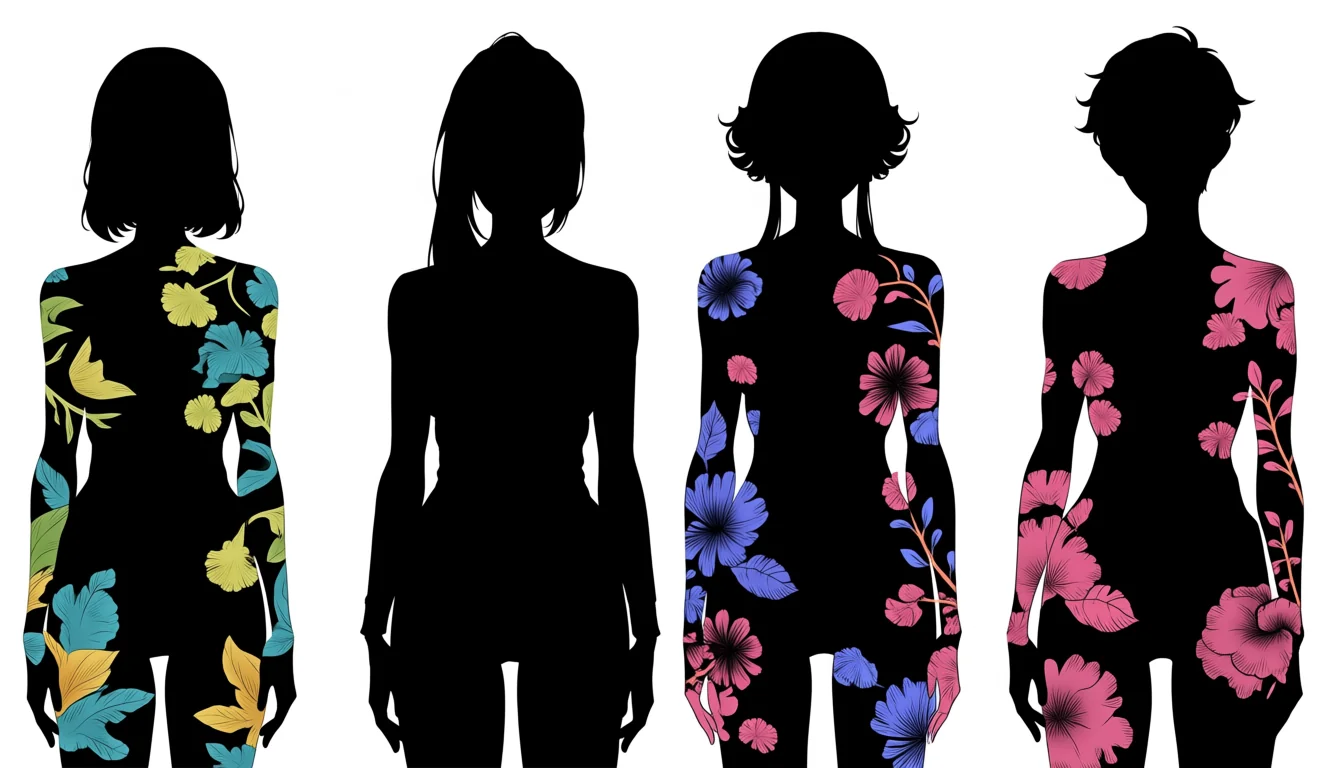
Character confusion is one of the most common complaints readers make about drawn work with more than three people in it, and creators are usually surprised by it, because from inside the work every character is obviously distinct. The gap exists because the creator identifies characters by face and the reader identifies them by outline, at a distance, in a panel two centimetres tall.
The audit that fixes this takes about an hour and is almost never done. It is worth doing before a long project starts and worth repeating whenever the cast grows.
How to run the audit
Draw or fill every character as a flat black shape, at the same height, standing in a neutral pose. Put them in a row. Shrink the row until each figure is about two centimetres tall, which is roughly how they will appear in an ordinary panel on a phone.
Then look. If you cannot immediately tell which is which, no reader will, and the problem is in the designs rather than in your drawing. Showing the row to somebody else and asking them to match names to shapes is a stronger version of the same test.
What usually goes wrong
Most casts fail because every character was built on the same construction, which produces the same proportions with different hair and faces. That is the base-mesh problem described in the piece on morph targets, arriving in drawn form.
The second common failure is that the differences are all in the face. Faces are invisible at small size, and a cast distinguished only by face is a cast that is indistinguishable in exactly the conditions readers meet it in.
Fixing it with structure
The strongest fixes are structural: different heights, different proportions between torso and limb, different shoulder and hip relationships, different builds. These are visible at any size and they persist regardless of costume, pose or framing.
This means real variation rather than scaling, which is the point made in the piece on the default body. A cast built by resizing one design will fail the audit no matter how different the numbers are.
Hair and posture do the rest
After structure, hair is the largest silhouette element and the easiest to vary decisively. Mass, length, whether it is tied, and how it behaves in motion are all silhouette decisions rather than detail decisions.
Posture is the underused one. A character who stands with her weight back, one who leans forward, one who keeps her arms close: these read at any size and they characterise as well as distinguish, which is why they belong on the character sheet as described in the sheet piece.
Costume is the weakest fix
Distinguishing characters by clothing works until somebody changes clothes, and in this material that happens frequently. A cast that relies on outfits becomes unreadable in exactly the scenes where legibility matters most, which is a poor place to discover the problem.
Costume is still worth varying, as a supporting layer on top of structural differences. It should not be doing the primary work, and if removing every garment collapses the cast into one shape, the underlying designs need attention.
Re-running the audit later
Casts grow, and a new character added in chapter six was designed without the row in front of you. Adding each new design to the silhouette row before drawing them into a page catches collisions while they are still free to fix.
It also catches drift, since characters change slowly over a long project. Comparing the current silhouettes against the original sheet occasionally shows whether two of them have been converging without anybody noticing.
Making a cast readable at two centimetres
Fill everybody black, line them up, shrink to two centimetres, and ask somebody else to name them. Fix failures with structure first, hair second, posture third, and costume last. Then repeat whenever the cast changes.
Characters here are fictional and unmistakably adult, and adult read must survive the same small-size test, as set out in the reader agreement.