
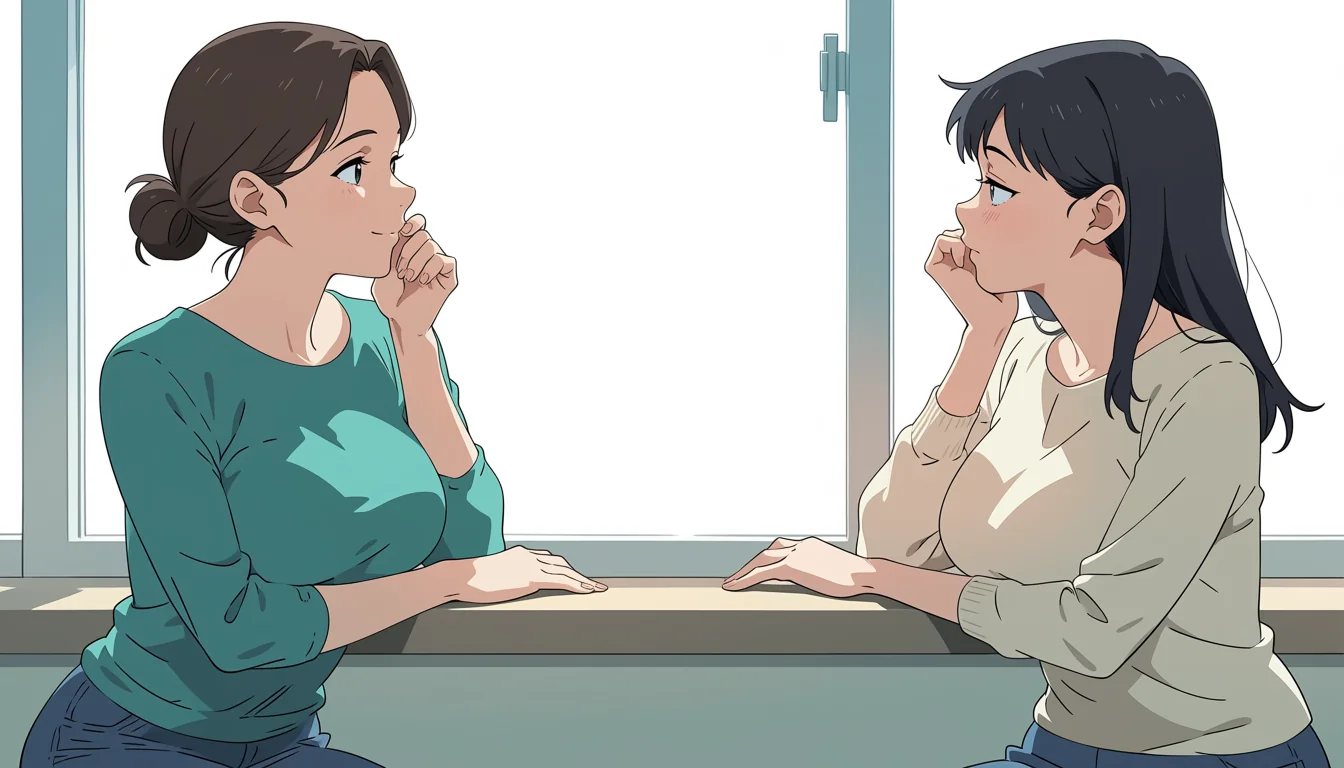
Ask what a good scene is about and the answer is usually an event: they argue, they meet, they go to bed. That describes what happens and not why the scene holds together. The scenes that hold together are almost always built around a single decision, and everything else in them exists to make that decision difficult.
This is a construction method rather than a theory, and it is unusually practical. Once the decision is named, most of the other questions about a scene answer themselves, including where it starts, how long it lasts, and what to cut.
Find the decision first
Before writing or drawing anything, name the choice. Whether she says it. Whether she stays. Whether she admits she already knew. The choice can be small and it should be genuinely open, meaning a reader could plausibly expect either outcome.
A choice that is not open is not a decision, it is an announcement, and readers detect that immediately. If the outcome is obvious from the first panel, the scene is delivering information rather than dramatising anything, and it will read as slack no matter how well executed.
Everything else makes it hard
Once the decision is named, every other element can be assessed by whether it makes the choice harder. The setting, the other character's behaviour, the time pressure, what has just happened. Anything that does not complicate the decision is either supporting it or wasting space.
This is a fast editing tool. Going through a draft and asking of each beat whether it makes the choice more difficult identifies the material to cut with unusual clarity, which is otherwise one of the hardest judgements in revision.
The decision should be visible
In drawn work, a decision is legible through hesitation, attention and physical change: a pause, a look, a movement begun and not completed. It rarely needs to be stated, and stating it usually weakens it, because a character who announces her choice has removed the reader's work.
The staging mechanics for this are covered in the piece on staging the approach, where the beats before an action carry the decision being made. The same structure applies to any decision, not only physical ones.
One decision per scene
Scenes that contain several decisions tend to resolve none of them well, because each needs setup and consequence and there is only so much room. Splitting them into separate scenes almost always improves both, and it produces the chaining structure described in the piece on what makes a scene.
The exception is a scene where one decision forces another immediately, which is a single dramatic movement rather than two. That reads as escalation and works well, but it should be recognised as one unit rather than treated as two.
Consequence is half the scene
A decision with no visible consequence is inert. Something must follow, even briefly: a reaction, a change in the room, a line that would not have been said otherwise. Ending immediately after the choice is the commonest way a well-built scene fails at the last moment.
This is the aftermath argument from the piece on writing power between characters, and it applies universally. What follows a decision is where the reader learns what it meant.
Scenes that genuinely have no decision
Some scenes exist to establish a place, introduce somebody, or let the reader breathe, and demanding a decision of them is a misapplication. The honest response is to keep them short and to fold as much of their work as possible into scenes that do have one.
A book with more than a couple of these tends to feel slow, and readers describe the problem as pacing when it is really structural. Recognising which scenes are load-bearing and which are connective tissue is what allows the connective tissue to be trimmed.
Constructing a scene around a choice
Name the decision, confirm it is genuinely open, make everything else complicate it, keep it visible rather than stated, limit yourself to one per scene, and show the consequence. Six steps, and they turn a sequence of events into a scene with a spine.
Characters here are fictional and unmistakably adult, as set out in the reader agreement.