
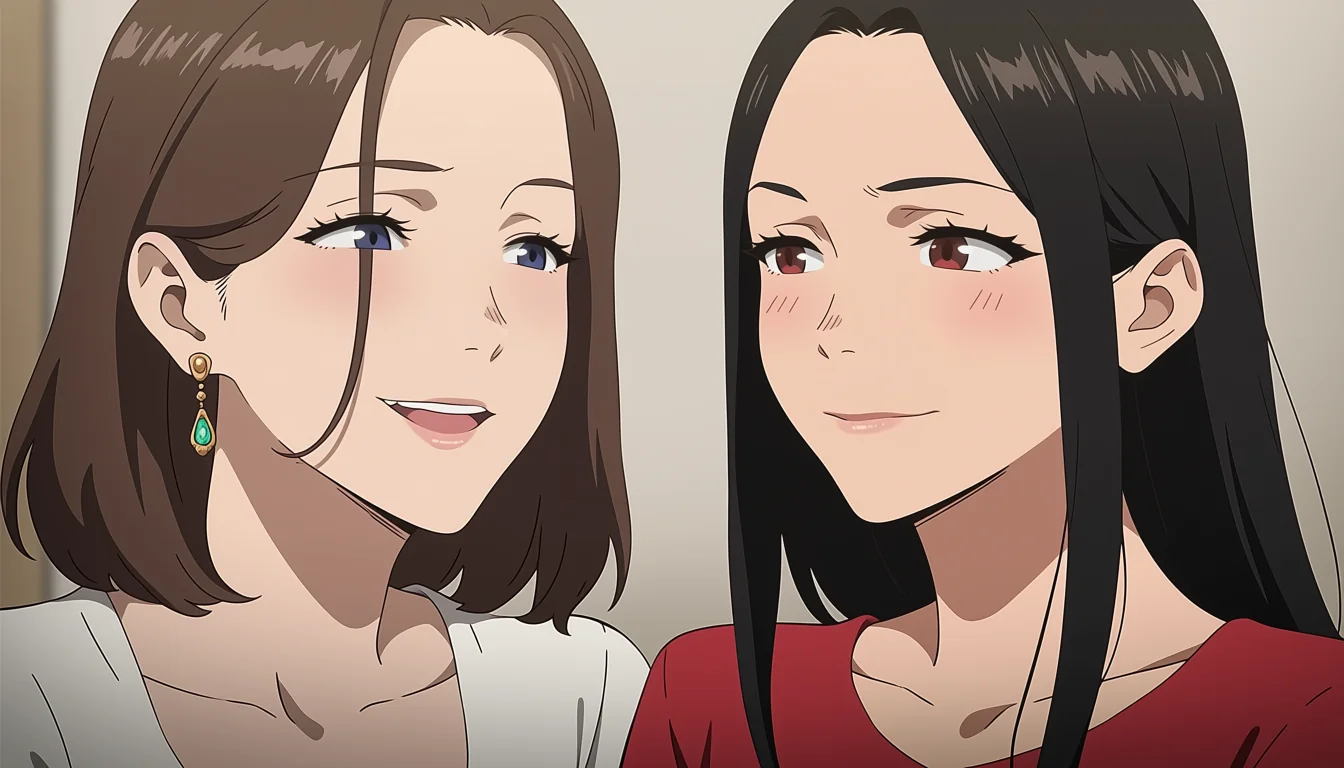
Every image places a viewer somewhere. In ordinary scenes that placement passes unnoticed; in intimate scenes it does a great deal of work, because where a reader is standing determines what kind of relationship they have to what they are seeing. It is the most consequential decision available and it is frequently made by default.
Making it deliberately does not require adopting any particular position. It requires knowing what each one says, so that the meaning of the finished scene is the one that was intended rather than the one that fell out of a convenient angle.
Eye level and participation
A camera at the characters' own height, at a distance a person in the room could occupy, reads as participation. The viewer is placed as somebody present, and the scene feels shared rather than watched. It is the most neutral position available and it is the one that best supports the mutual attention described in the piece on visible consent.
It is also the least dramatic, which is why it gets abandoned. A whole scene at eye level can feel flat, and the usual solution is to vary distance rather than height, keeping the participatory position while changing how close the viewer stands. That preserves the relationship while giving the sequence rhythm.
High angles and observation
Looking down on a scene from above places the viewer outside it, above the characters, in a position nobody in the room occupies. That reads as observation, and depending on how far it is pushed it can read as detachment, judgement, or something less comfortable. It is not a forbidden angle; it is a loaded one.
The load is worth using deliberately. A single high angle at a moment of vulnerability says something specific. A whole scene shot from above says something else entirely, and usually not what the artist would have chosen if asked directly.
Low angles and power
Looking up at a figure makes her larger and more dominant in the frame, which is a statement about power that the scene may or may not want to make. In two-character work, an asymmetric use of high and low angles builds a hierarchy between the characters that persists even when the writing says otherwise.
Consistency matters here. If one character is repeatedly shot from below and the other from above, the images are making a claim about the relationship, and readers read images faster than they read text. This is where a scene can quietly contradict its own dialogue.
Impossible positions
Cameras placed where no person could be, inside furniture, through walls, or floating above a bed, announce themselves as apparatus. That can be a legitimate stylistic choice, and it removes the participatory reading entirely, replacing it with an explicitly constructed view.
Used occasionally for a specific effect, it works. Used constantly, it produces the sense that the scene is being surveyed rather than inhabited, and it tends to accompany the framing failures described in the choreography notes, where one participant becomes scenery.
Changing position changes the relationship
Moving between positions during a scene changes what the reader is being asked to feel, and if the moves are not motivated the scene becomes unstable. A sequence that starts at eye level, moves to a high angle for the central moment and returns is telling a small story about distance whether or not anybody planned one.
So plan the arc of positions the way you would plan the arc of shot sizes, described in the piece on panel rhythm. Where the viewer stands at the beginning and the end is a structural decision, not a coverage detail.
Distance interacts with all of this and is easier to control. A viewer standing far enough back to see a whole room is a different person from one close enough to see only a face, and moving between those two is the ordinary way a sequence breathes. Where height carries judgement, distance carries intimacy, and it can be varied freely without making claims about power.
Choosing where the reader stands
Decide the default position for the scene, decide where it deviates and why, keep high and low angles symmetrical between characters unless the asymmetry is the point, and use impossible positions sparingly. Then check the whole sequence for a position arc you did not intend.
Characters here are fictional and unmistakably adult, as set out in the reader agreement.