
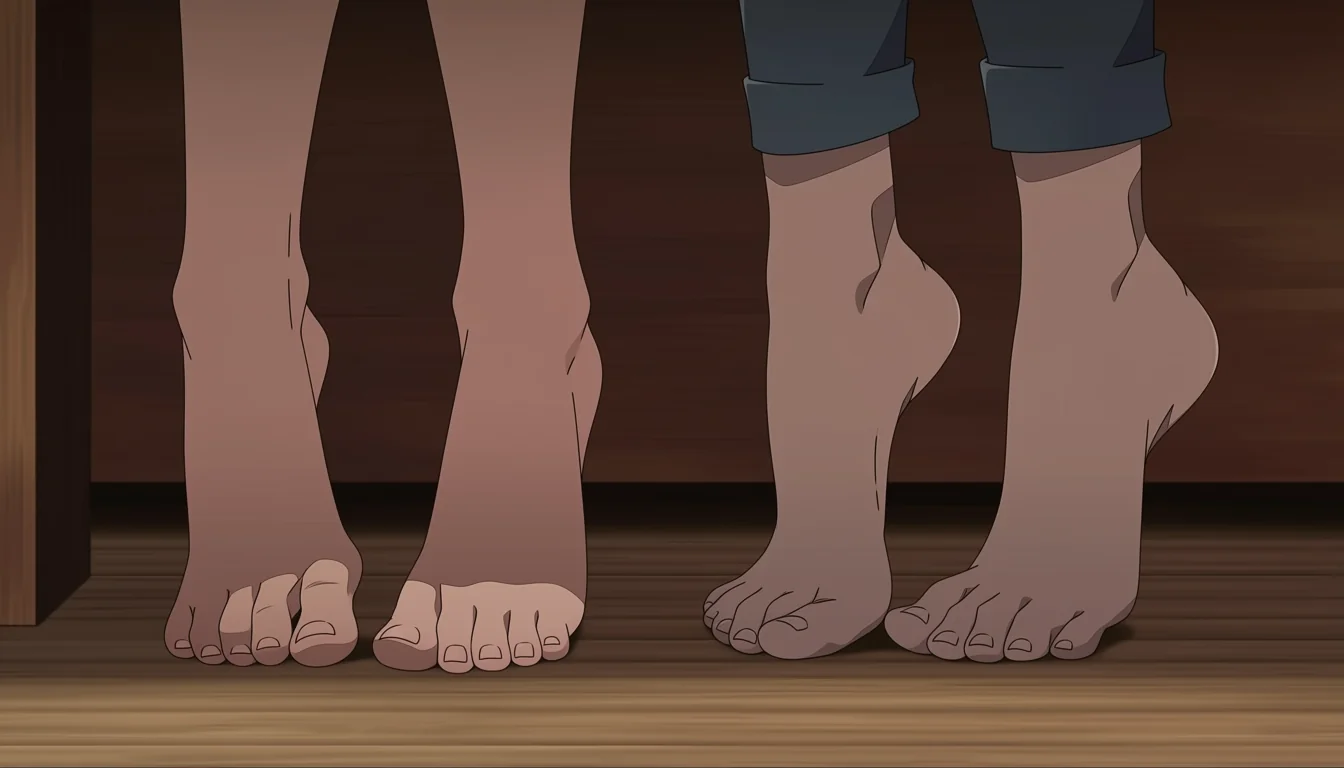
Look through almost any portfolio and a pattern appears: feet are cropped, obscured by furniture, angled away from the viewer, or reduced to a shape with a toe suggestion. The avoidance is understandable, because feet are genuinely difficult and they are boring to practise. It is also expensive, because it quietly removes a large set of poses from what an artist can draw.
Grounding is the specific loss. A figure whose contact with the floor is vague reads as hovering, and the whole image loses weight regardless of how well the rest is drawn. That is the same weight problem described in the piece on floaty motion, arriving through a different door.
The arch does the work
A foot is not a flat plane with toes. It is an arched structure carrying the entire weight of the body onto a small area, and everything about its shape follows from that. The arch on the inside is pronounced, the outside edge stays close to the ground, and the whole thing flexes visibly as load moves across it.
Drawing the arch first solves most problems immediately. It establishes which parts touch the ground, gives the ankle somewhere plausible to sit, and produces the inward tilt that makes a foot read as a foot rather than as a shoe shape. Skipping it is why so many drawn feet look like flippers attached at the wrong angle.
Weight changes the shape
A loaded foot spreads. The toes splay slightly, the arch flattens, and the flesh at the contact points compresses and widens. An unloaded foot does the opposite: the arch rises, the toes relax and curl a little, and the whole form becomes narrower. Drawing the same shape in both cases is the second most common error after the flat wedge.
This is what makes standing poses read as standing. A figure with two identical unloaded feet planted on a floor looks placed rather than balanced. Deciding which foot carries the weight, and drawing the consequences, is a small decision with a disproportionate effect on how solid the whole figure looks.
Three masses make it manageable
A workable simplification is to think of three masses: the heel as a rounded block, the arch and instep as a wedge rising from it, and the ball of the foot as a broader pad with the toes attached. Build those three before any detail, and the perspective problem becomes ordinary rather than mysterious.
Toes are then a small addition rather than the main event. Drawn as five separate cylinders they look wrong; drawn as one connected mass with divisions, they look correct. This is the same principle as treating hair as masses rather than strands, discussed in the notes on cloth and hair.
Why avoidance costs more than it saves
Every crop that hides a foot restricts a composition. Every pose chosen because it conceals one removes options that might have been better. Over a long project this accumulates into a visible sameness of framing, and the artist usually cannot see it because each individual decision felt like a reasonable choice at the time.
It also affects intimate work specifically, where reclining and seated poses are common and where the lower half of the body is frequently in frame. Feet drawn badly in those compositions pull attention exactly where you do not want it, because errors attract the eye more reliably than successes do.
Footwear is a related dodge worth naming. Shoes hide the structure while introducing their own, and a shoe drawn without a foot inside it collapses into a shape with no bones in it. The economical answer is to learn the bare structure once and then treat shoes as fabric and leather stretched over it, which is the same relationship described in the piece on how fabric describes a body.
Learning a part you have been hiding
The fix is dull and effective: draw the arch, decide the load, build three masses, add toes as a group. Twenty minutes a day for a fortnight will move most artists from avoidance to competence, which is a very good return for a body part that appears in a large fraction of full-figure work.
The general principle, that structure precedes rendering, runs through everything here and is covered in the piece on drawing soft structure. Characters here stay fictional and unmistakably adult, as set out in the reader agreement.