
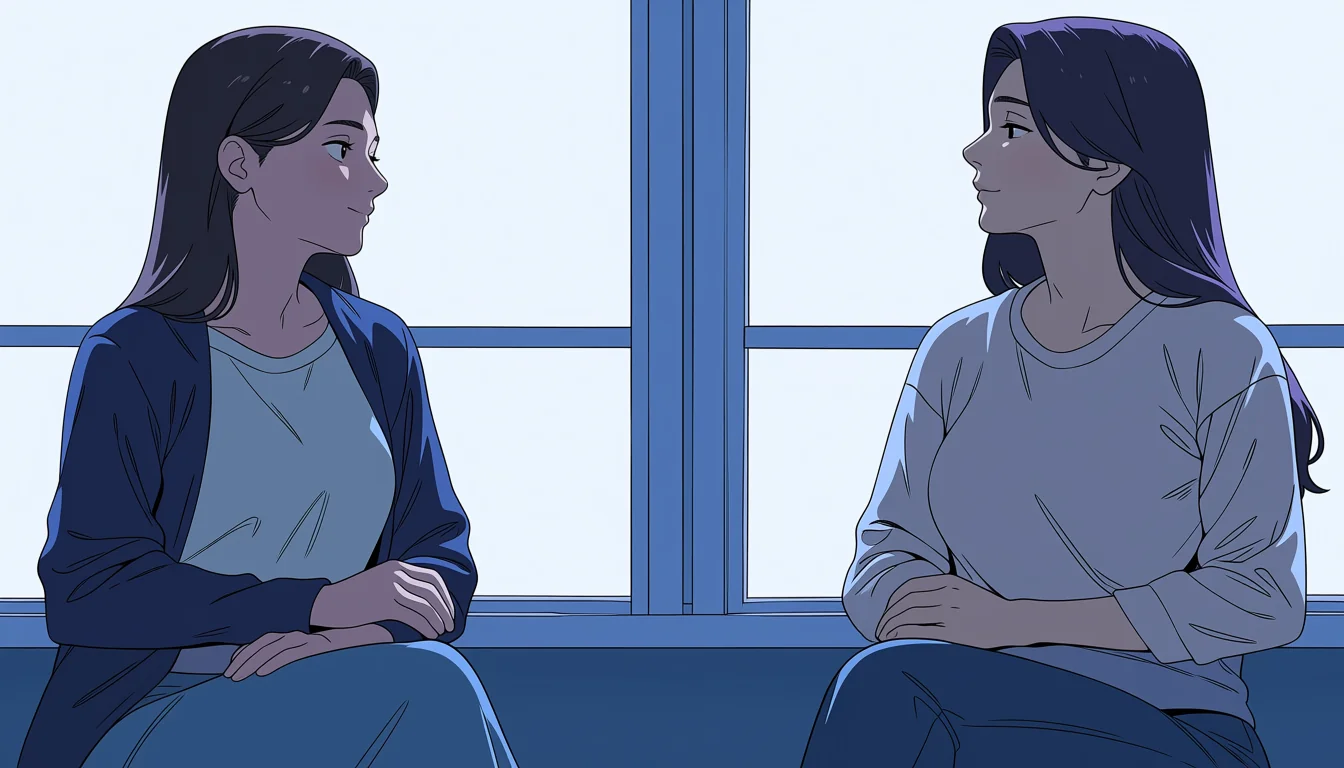
A scene means what its ending says it means. Two characters can do exactly the same things and the encounter can read as tender, careless, funny or bleak depending entirely on what happens in the following minutes. Most drawn work never shows those minutes, which leaves the interpretation to the reader and frequently produces a flatter result than intended.
This is a structural observation before it is an ethical one, though it happens to be both. The endings that read as responsible are also the endings that make a scene land, which is a pattern that recurs throughout this subject.
Endings interpret what came before
Readers assemble meaning retrospectively. An encounter followed by two people making tea and talking about something unrelated reads completely differently from the same encounter followed by one of them leaving without a word, and neither reading was available until the final panels arrived.
That makes the ending the most efficient place to change what a scene says. Rewriting the middle is expensive; changing what follows is a page, and it alters the whole sequence retroactively.
Most work stops a beat early
The commonest structural fault is cutting at the peak. It feels like a strong ending and it leaves the scene without consequence, which is the missing-change problem set out in the piece on what makes a scene. The reader gets an event and nothing to do with it.
The fix is small: a few panels of return to ordinary time. Breathing, adjusting, one line of dialogue, somebody finding their clothes. It costs almost nothing in space and it converts an event into something that happened to two specific people.
Aftercare is behaviour, not an appendix
Where a scene has involved intensity of any kind, what follows it is part of the practice rather than an add-on, as described in the piece on borrowed rope traditions. Depicting it accurately means depicting it as ordinary and attentive rather than as a separate ceremonial section.
Practically that means small physical business: untying, water, a blanket, checking. These read as competence and care simultaneously, and they characterise both people through what each does without anybody saying anything about their feelings.
What an ending has to contain
Three things, and none of them large. A change of physical state, so the bodies return to ordinary posture. A moment of attention between the two characters. And something that indicates what happens next, even if it is only that one of them stays.
Any two of the three will carry a scene. All three make it feel finished. Zero of them is the cut-at-the-peak ending, which readers describe as abrupt without usually being able to say what was missing.
Endings across a long work
In serialised work the ending of each scene also has to hand something to the next, which is the chaining structure described in the piece on what makes an explicit scene work. An ending that resolves everything stops the story; one that resolves the immediate and opens something small keeps it moving.
That is another argument against cutting at the peak, since a scene with no aftermath has nothing to hand forward and the next scene has to start from nothing.
The quiet page is usually the memorable one
Readers frequently name a quiet page as their favourite in a book, and it is nearly always an aftermath. That is not sentimentality; it is that a quiet page carries information the loud ones cannot, because the characters are recognisable again and their behaviour is legible.
It is also the cheapest page in the book to draw well, since it needs ordinary rooms and ordinary bodies rather than complex staging. The return on attention there is unusually high.
Giving a scene somewhere to land
Do not cut at the peak. Return to ordinary time, show a change of physical state, keep one moment of attention between the characters, and indicate what follows. A page, sometimes half of one, and it decides what the whole sequence meant.
Characters here are fictional and unmistakably adult, as set out in the reader agreement.